By EDDIE PELLS AP National Writer
The NCAA announced Thursday that it will expand its two March Madness tournaments by eight teams each next season, a long-expected move that will drop more games into the first week of the highly popular and lucrative showcase without substantially changing its overall form.
The new, 76-team brackets will jam eight extra games — for a total of 12 involving 24 teams — into the front half of the first week of the men’s and the women’s tournaments. It will turn what’s now known as the First Four into a bigger affair that will now be called the “March Madness Opening Round.”
The 12 winners will move into the main 64-team bracket that will begin, as usual, on Thursday for the men and Friday for the women.
It is the first expansion of the tournaments in 15 years, when they were bumped to 68 teams each.
The NCAA said it will distribute more than $131 million in new revenue to schools that make the tournament. That money will come via expanded TV advertising opportunities for alcohol, the likes of which were previously restricted. It said the value of the rights agreement will increase $50 million each year on average over the course of the six years.
Most of the eight new slots are expected to go to teams from the power conferences that were already commanding the lion’s share of entries in the bracket. Two years ago, the Southeastern Conference placed a record 14 teams in the men’s bracket. Last season, the Big Ten had nine.
Keith Gill, the chairman of the Division I men’s basketball committee, called the expansion “a nice way to create some access but make sure we have the bracket we all love when we start Thursday at noon.”
The move is a product of the times, which includes massive expansion — the Atlantic Coast Conference, for instance, has grown from nine to 17 teams since 1996 — and the reality that mid-major schools with top-notch players will often see them plucked away by programs with bigger budgets and the ability to pay them through revenue sharing.
Cinderella? There will still be room for those stirring runs in the tournaments, though not a single mid-major advanced past the first weekend of either tournament the last two seasons.
This is hardly a concern of the decision-makers anymore, who will point to TV ratings that traditionally spell out fans’ preference for the likes of Duke and North Carolina over St. Peter’s and San Diego State, especially once the Sweet 16 starts.
What matters more to the biggest schools is that their teams have a chance to compete in what remains the best postseason in college sports and that they aren’t iced out by lower conference champions who earn automatic bids.
“You’ve got some really, really good teams who are going to end up in that 9, 10, 11 (seed) category that I think should be moved into the” 64-team bracket, SEC commissioner Greg Sankey said last year in discussing how he favored expansion.
Also, the money. The new beer and wine money will add to what the NCAA can distribute in “units” that are earned for placing teams in the bracket and then for every round those teams advance. Last year, that amounted to about $350,000 per unit for the men’s tournament. The Big Ten made nearly $70 million from both tournaments, won by conference members Michigan (men) and UCLA (women).
Leaders in the SEC, Big Ten, Big 12 and ACC have all acknowledged that smaller programs help make March Madness what it is, all the while steadily expanding their own power in NCAA decision-making. That brings with it the tacit threat of fracturing the single thing the NCAA does best — the basketball tournament.
This move might forestall that. What it isn’t expected to do is drastically change the TV deal beyond the advertising.
The current deal for the men’s tournament is worth $8.8 billion and runs through 2032. Adding a few extra games between mid-level Power Four teams on Tuesday and Wednesday won’t change that much.
One of reason this took as long as it did was the NCAA negotiations with CBS and TNT, which themselves have been in negotiations over their own ownership.
The more drastic option of expanding the tournament to 96 teams or beyond would involve adding an extra week to a tournament that has thrived in part because of the symmetry of a six-round bracket that gets whittled down over three weeks.
That basic shell began in 1985, with only slight tweaks, the latest of which came in 2011 when it was upped to 68.
___
AP March Madness: https://apnews.com/hub/march-madness
News
March Madness tournaments will expand to 76 teams each starting next season
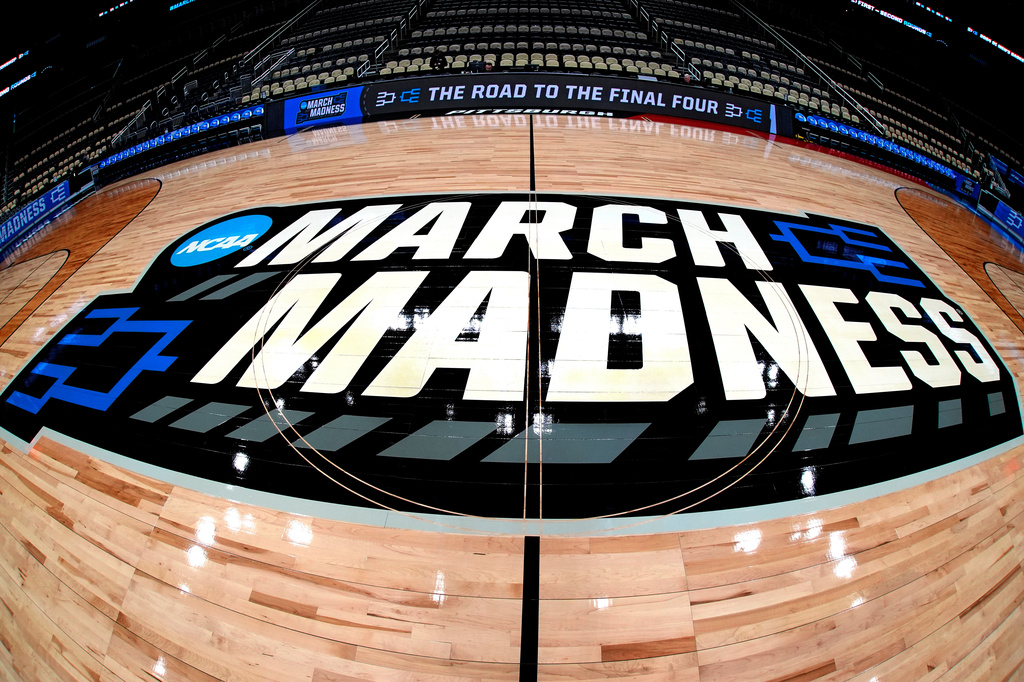
FILE - March Madness logo sis displayed at center court during the opening rounds of the NCAA college basketball tournament in Pittsburgh, Wednesday, March 20, 2024. (AP Photo/Gene J. Puskar, File) Photo: Associated Press